
Summary
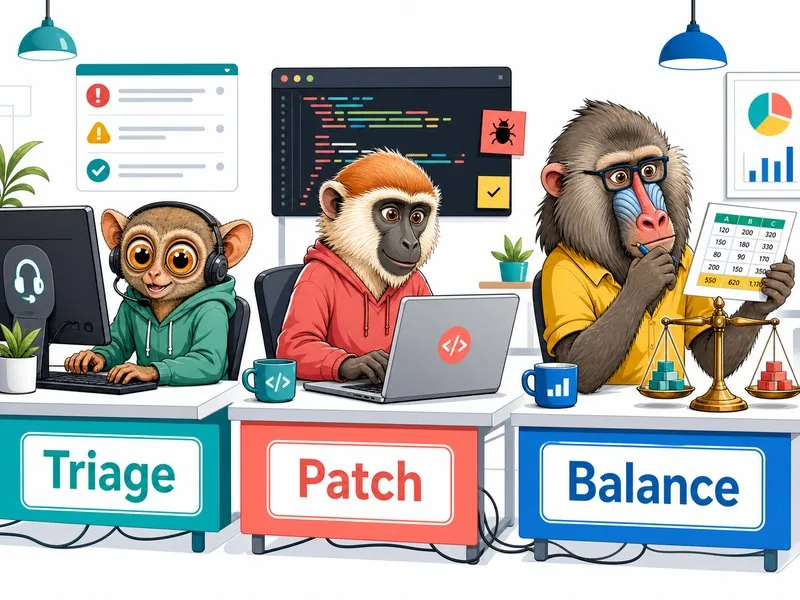
The Kanzi Simian Army is Rightware's trio of special-purpose Slack agents: Triaging Tarsier, Patching Patas, and Balancing Baboon. Each runs on a trigger, reports its results, and opens itself up to threaded team discussion. Built on Amazon Bedrock AgentCore, they handle Zendesk ticket routing, dependabot patch management, and account reconciliation, giving Rightware a clean, IT-friendly foundation for the agentic era of HMI.

Case Study
I've been collaborating with Rightware on various projects for quite a while, and when they learned about my work with agents, I was asked to help them with their transition to an agent-first restructuring of their entire organization.
Rightware makes the Kanzi engine, which is used to create embedded graphical interfaces for brands such as Toyota, Audi, Ford, Mercedes-Benz, Stellantis, Maserati and Jaguar. Like all graphical platforms, they are facing a challenging market dynamic where the expectation is that graphical assets, and even entire cockpit designs, can be achieved through prompting. Rightware's edge has always been a deep understanding of how to achieve beautiful results on heterogeneous and challenging hardware, and their goal going forward will be to maintain this edge while adapting Kanzi to the new market reality.
Rightware, if it is known for anything, is brash egos with bold visions and big dreams that do not necessarily get along with each other. This is how, being a small company with small funding compared to their competition, they were able to win over some of the largest car vendors in the world. It is also why it is hard for new initiatives to get traction: everyone has legitimately good ideas of where to go, and only the best ideas that survive the longest can turn a gregarious group of leaders into followers. You could see the pattern in how they'd taken to agents: the majority of the organization needed no prodding to start experimenting, and by the time anyone looped me in, multiple teams had already built sophisticated prototypes, some of them live. Which was the problem in miniature: everyone had gone and built their own.
My task at Rightware was to take the outward-facing agent work they had done, which includes documentation and hooks into Kanzi itself, and turn the looking glass inward, finding a way for agents to energize and impact the company internally. This is a tall order: Rightware's strength is the high autonomy of its teams, but this strength makes it challenging to devise efforts that are cross-team by design and share knowledge. As a result, the types of strategies I used for Tapio, Steve the Hedgehog, and Bob Dobbs would not work here.
I started by interviewing stakeholders that had already built internal agents and those who had expressed a desire for specific workflows that did not exist yet. Several themes emerged: the creators of agents were completely unattached to any given model or agentic technology: they only cared that the agent worked a particular way. IT had a severe allergy to the claw ecosystem: the security nightmare of exposing secrets and the maintenance burden led them to favor managed solutions. No one wanted a general purpose agent: they wanted agents with instantly understandable scope. And there was no desire to talk to agents or for them to have a personality.

I found the last point interesting because it fell outside of my thesis. Up until this point, I had only built strongly branded agents whose strength was their dialectical engagement with teams. The idea of autonomous agents that are basically siloed from day-to-day communication is something I wasn't personally interested in building, but also something I wasn't quite sure the team needed. In fact, I felt the opposite to be true: the reason that internal agents hadn't really taken off is precisely because the attempts that existed were too detached from the team. They were "set-and-forget" in a way that added little value to the team's day-to-day operations.
So my task became finding a sort of agent "brand" that could maintain the required diversity of agentic work while at the same time creating a sense of ownership of and discussion with agents so that they improved over time and became more useful.

"Harmonizing the design of small, special-purpose agents that are as expressive as claws without the maintenance burden has proven to be a durable foundation."
The result is Kanzi agents. For those of you who don't know the story of Kanzi, he is a bonobo whose vocabulary came to rival that of a young human, and who, remarkably, was never formally taught it: he picked it up on his own, sitting in on the lessons researchers were giving his mother. I borrowed Rightware's ape-centric marketing, as well as Netflix's concept of a Simian army, to create agents with memorable names: Triaging Tarsier (Zendesk ticket routing), Patching Patas (dependabot watcher), and Balancing Baboon (account reconciliation).
All three agents share the same DNA: they act on a trigger or cron, report status, run periodic integration tests, and, most importantly, they all have an ad-hoc chat function within Slack. Their posts can be threaded and become the object of a discussion for a team member who needs clarification or has an idea about how to improve the agent. The agents' results can have a long tail of deliberation without the "always on" overhead built into my other agents.
The agents all use Amazon Bedrock AgentCore, which gives IT a clear and managed surface area to monitor and maintain, and makes future agents easily developable and deployable using the existing agents as templates. Other teams are migrating their internal agents to this repo and adopting the same simian naming pattern and long tail discussion possibility.

At the end of the day, a general-purpose, always-on agent wouldn't make sense for Rightware. The organization is too diverse, and the ideas are too heterogeneous, for that sort of agent to be useful. Instead, harmonizing the design of small, special-purpose agents that are as expressive as claws without the maintenance burden has proven to be a durable foundation as Rightware transitions into, and leads, the agentic era of HMI.